# Step-by-Step Process to Close an NRI Account in India
Author: Ankur Choudhary
Author URL: https://getbelong.com/blog/author/ankur-choudhary/
Published: 2025-09-22
Category: NRI Banking
Category URL: https://getbelong.com/blog/category/nri-banking/
Meta Title: How to Close NRI Account in India - Complete Guide
Meta Description: Complete guide to close your NRE, NRO or FCNR account in India. Learn documents needed, tax implications, and step-by-step process.
Tags: NRI Banking
Tag URLs: NRI Banking (https://getbelong.com/blog/tag/nri-banking/)
URL: https://getbelong.com/blog/nri-account/close-account/

"I want to close my NRI account in India, but I'm confused about the process.
Will I lose money to taxes? What documents do I need? Can I do this from abroad?"
If you're asking these questions, you're not alone. Every month, thousands of NRIs face this exact dilemma. Some are returning to India permanently.
Others want to consolidate their finances. Many simply want to avoid maintenance charges on dormant accounts.
The confusion is real. One bank asks for Form A, another wants Form 15CA. Your friend says you can do everything online, but your bank insists on a branch visit.
## **Quick Answer (Summary Verdict)**
**Yes, you can close your NRI account from anywhere in the world.** The process typically takes 7-15 days and requires specific documents based on your account type. Here's what matters most:
- **NRE accounts**: Full repatriation allowed, minimal documentation
- **NRO accounts**: USD 1 million annual repatriation limit, tax compliance required
- **FCNR accounts**: Complete repatriation possible, no tax implications
**👉 Key insight**: Closing isn't always the best option. Sometimes converting to a different account type saves money and keeps your options open.
## **The Full Picture**
Let me share what happened to Raj from Dubai last year. He wanted to close his ICICI NRO account because he wasn't using it. The bank charged him ₹5,000 in penalties and he lost ₹45,000 to unnecessary TDS.
Why? He didn't know the rules.
**When NRIs typically close accounts:**
**Scenario 1: Returning to India permanently**
You need to [convert your NRE and NRO accounts](https://getbelong.com/blog/convert-nri-account-to-resident-account/) to resident accounts or close them entirely. Under FEMA regulations, you cannot hold NRI accounts as a resident Indian.
**Scenario 2: Simplifying finances**
Managing multiple accounts across banks becomes expensive. Many NRIs consolidate their banking with one trusted institution.
**Scenario 3: Switching to better options**
Traditional NRE FDs give 6-7% returns. Meanwhile, [GIFT City investments](https://getbelong.com/blog/gift-city-investments/) offer tax-free USD returns without currency risk.
**Current regulations (2025):**
FEMA mandates that you must either close your resident accounts or convert them to NRO accounts when you become an NRI. Failure to comply can result in penalties up to three times your account balance.
## **Benefits of closing an NRI Account**
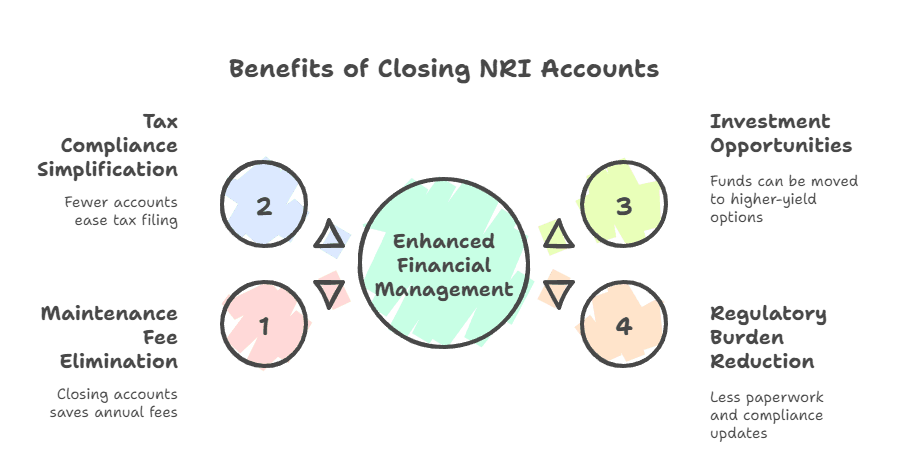
**1\. Eliminates maintenance fees**
Most banks charge ₹2,000-5,000 annually for dormant NRI accounts. Closing saves these charges.
**2\. Simplifies tax compliance**
Fewer accounts mean simpler ITR filing. You avoid unnecessary [TDS complications](https://getbelong.com/blog/tds-for-nri-section-195-rules-rates-compliance/) on minimal balances.
**3\. Access to better investment options**
The money can be moved to higher-yield investments like [GIFT City funds](https://getbelong.com/blog/gift-city-funds/) or [alternative investment funds](https://getbelong.com/blog/all-about-alternative-investment-funds-aif/).
**4\. Reduces regulatory burden**
Fewer KYC updates, fewer compliance requirements, less paperwork.
**👉 Tip: Before closing, check if your bank offers** [**NRI fixed deposit laddering strategies**](https://getbelong.com/blog/nri-fd-laddering-strategy/) **to maximize returns on your existing balance.**
## **What to Watch Out For**
**1\. Tax implications vary by account type**
Interest on NRO accounts is taxable at 30% TDS, while NRE and FCNR account interest is tax-free in India. Closing an NRO account triggers immediate tax calculations on accrued interest.
**2\. Repatriation limits apply**
NRO account holders can repatriate maximum USD 1 million per financial year after tax deductions. NRE and FCNR accounts have no repatriation limits.
**3\. Currency conversion costs**
Banks charge 1-2% on forex conversion. For large amounts, this can mean thousands of dollars in fees.
**4\. Documentation requirements differ by bank**
SBI needs different forms compared to ICICI or HDFC. Some banks accept email submissions, others require physical visits.
**5\. Closure might not be reversible**
Opening a new NRI account later involves fresh KYC, documentation, and potential delays.
**👉 Warning**: Don't close accounts with pending investments like mutual funds or [PPF accounts](https://getbelong.com/blog/ppf-meaning-rules-and-alternatives-for-nris/). Settle these first to avoid complications.
## **Step-by-Step How-To**
### **Phase 1: Pre-Closure Preparation**
**Step 1: Determine your account types**
Log into net banking and list all accounts. Note the type (NRE/NRO/FCNR) and current balances.
**Step 2: Clear all dues**
- Cancel recurring deposits and SIPs
- Clear any loan EMIs linked to the account
- Stop all ECS mandates and standing instructions
- Return unused cheque books and debit cards
**Step 3: Transfer linked investments**
If you have mutual funds or stocks linked to these accounts, [update your bank account details](https://getbelong.com/blog/how-nris-can-invest-in-mutual-funds-in-india/) with the AMC or broker.
### **Phase 2: Documentation**
**For all account types, you'll need:**
Document
Purpose
Where to get
Account closure form
Formal request
Bank website or branch
Copy of passport
Identity proof
Self-attested copy
Current visa/residence permit
Address proof
Embassy/immigration
PAN card copy
Tax identification
Income tax department
Cancelled cheque
Bank verification
Your cheque book
**Additional for NRO accounts:**
- Form 15CA (for repatriation > ₹50,000)
- Form 15CB (CA certification for tax compliance)
- [Tax residency certificate](https://getbelong.com/blog/uae-tax-residency-certificate-guide/) (for DTAA benefits)
**👉 Tip**: Download forms from your specific bank's website. ICICI, SBI, and HDFC have different formats.
### **Phase 3: Submit Closure Request**
**Option 1: Online submission (recommended)**
Most banks now accept closure requests via email. ICICI Bank allows initial requests through their iMobile app, though final verification may require additional steps.
1. Fill the closure form completely
2. Scan all documents in PDF format
3. Email to your bank's NRI services address
4. Request email confirmation of receipt
**Option 2: Branch visit**
If you're in India, visit the branch where you opened the account. Carry original documents for verification.
**Option 3: Postal submission**
For those abroad, most banks accept closure requests by mail with notarized documents. Use registered mail with tracking.
### **Phase 4: Fund Transfer Instructions**
**Specify where your money should go:**
**For NRE/FCNR accounts:**
- Transfer to overseas account (provide SWIFT details)
- Transfer to another NRE account in India
- Convert to demand draft
**For NRO accounts:**
- Transfer to overseas account (within USD 1 million limit)
- Transfer to [NRE account](https://getbelong.com/blog/best-nre-savings-accounts/) (with proper documentation)
- Keep in India (transfer to resident account)
### **Phase 5: Follow-up and Confirmation**
**Timeline expectations:**
- Processing: 7-15 business days
- Fund transfer: Additional 3-7 days
- Final confirmation: Email/SMS notification
**👉 Important**: Keep the closure confirmation letter. You'll need it for tax filing and future reference.
## **Final Recommendation**
Closing your NRI account isn't just about paperwork - it's a financial decision that affects your future options.
**When to close:**
- You're returning to India permanently
- Account has minimal balance (\\< ₹50,000)
- You've found better investment alternatives
**When NOT to close:**
- You might return to NRI status
- Account balance is substantial
- You have ongoing India income sources
**Better alternatives to consider:**
1. **Convert to RFC account**: If returning to India, this keeps foreign currency intact
2. **Switch to GIFT City deposits**: Tax-free USD returns without currency risk
3. **Consolidate with one bank**: Keep one account active, close others
**Your next steps:**
1. Evaluate if closure is really necessary
2. Compare [the best NRI accounts](https://getbelong.com/blog/best-nri-account/) available today
3. Consider [GIFT City investment options](https://getbelong.com/blog/belong-nri-investment-gift-city/) for better returns
Remember, the goal isn't just to close an account - it's to optimize your financial position. Sometimes that means closing, sometimes it means switching to better options.
**Ready to explore better NRI investment options?** Join thousands of smart NRIs who've discovered tax-free USD investments in GIFT City.
[Join our WhatsApp community](https://chat.whatsapp.com/EaxmhRZ6fTiChXQAZhqFK4) for personalized guidance on NRI banking and investments.
[Download the Belong app](https://app.getbelong.com/LywZ/blogs) to explore GIFT City investments that offer tax-free returns without currency risk.
* * *
**Sources:**
- [Reserve Bank of India - FEMA Guidelines](https://rbi.org.in/)
- [Income Tax Department - NRI Taxation Rules](https://incometax.gov.in/)
- [ICICI Bank NRI Banking Guidelines](https://icicibank.com/nri-banking)
- [State Bank of India - Account Closure Process](https://sbi.co.in/)
## FAQs
Q: Can I close my NRI account online?
A: While you can initiate closure requests online through mobile apps or email, most banks require document verification which may need branch interaction or postal submission.
Q: What happens to my fixed deposits?
A: You can either break them (with penalty) or wait for maturity. NRO and NRE FDs have different closure rules. FCNR deposits in GIFT City might offer better alternatives.
Q: Can I reopen the same account later?
A: No. You'll need to apply fresh with new documentation. This is why many NRIs prefer converting accounts rather than closing them.
Q: Will I pay tax on closure?
A:
NRE/FCNR accounts: No tax on interest earned
NRO accounts: 30% TDS on interest (can be reduced with DTAA benefits)
Q: Can someone else close my account?
A: Yes, with proper power of attorney documentation. The authorized person must visit the branch with notarized authority letters.
---
This blog is powered by Superblog. Visit https://superblog.ai to know more.
---